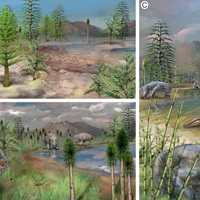


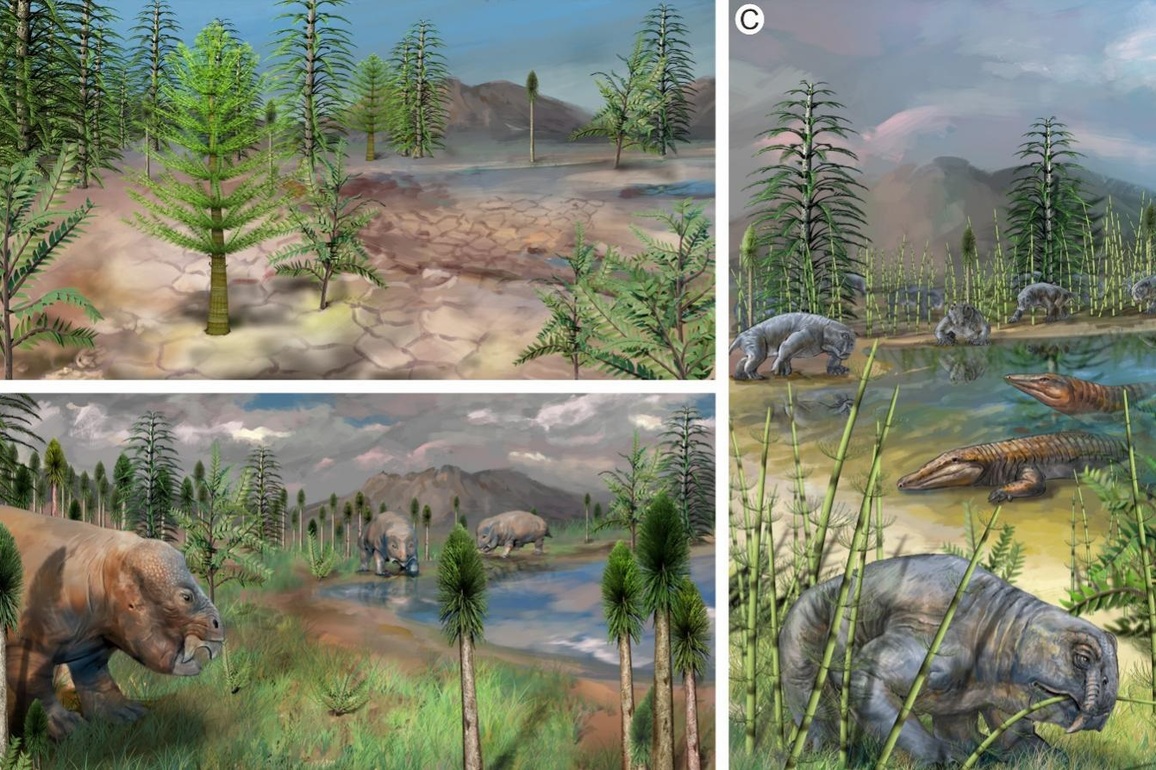
(250313) -- NANJING, March 13, 2025 (Xinhua) -- This image shows the reconstruction of the terrestrial landscape before (B), during (A), and after (C) the mass extinction at the end of the Permian Period in the South Taodonggou section of the Turpan-Hami Basin in northwest China's Xinjiang Uygur Autonomous Region.
A new study has revealed that a region of the Turpan-Hami Basin in northwest China's Xinjiang Uygur Autonomous Region was an "oasis of life" for terrestrial plants during a catastrophic biological crisis that occurred on Earth about 252 million years ago.
The study, led by researchers from the Chinese Academy of Sciences' Nanjing Institute of Geology and Palaeontology, was published in the Science Advances journal on Thursday.
TO GO WITH "Across China: Study finds 'oasis of life' thrived in NW China during Earth's worst mass extinction" (Chinese Academy of Sciences' Nanjing Institute of Geology and Palaeontology/Handout via Xinhua)