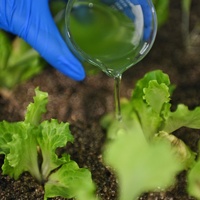


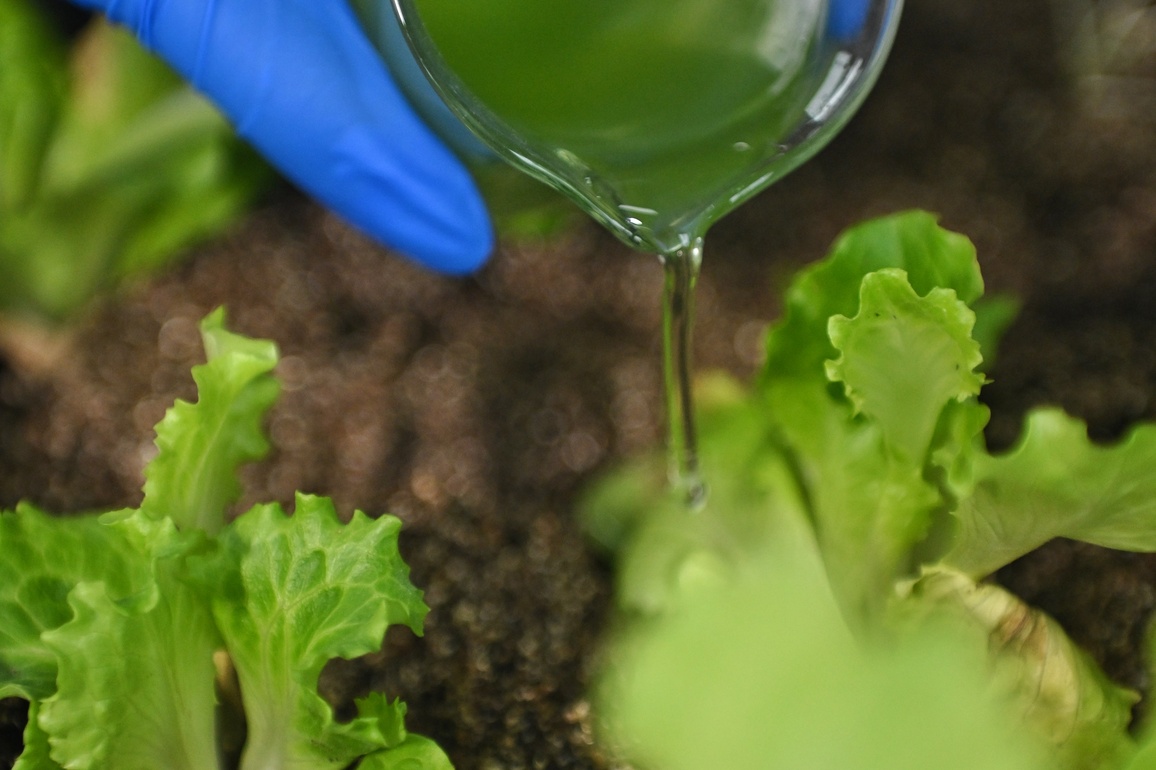
(250322) -- CHENGDU, March 22, 2025 (Xinhua) -- A researcher of an innovation team specializing in synthetic microbiomes and wastewater resource utilization of the Chengdu Institute of Biology, Chinese Academy of Sciences, uses algal solution to fertilize vegetables at a laboratory in Chengdu, southwest China's Sichuan Province, March 20, 2025. In recent years, an innovation team specializing in synthetic microbiomes and wastewater resource utilization of the Chengdu Institute of Biology, Chinese Academy of Sciences, has conducted a series of studies on pollutant conversion and wastewater resource utilization. The research results indicate that after treatment with microalgae, wastewater from sources such as domestic sewage, aquaculture effluent, livestock wastewater, and black and odorous water bodies not only meets discharge standards but can also be converted into feed and fertilizers.
"Microalgae refer to tiny algae that can only be distinguished under a microscope. We have selected and cultivated microalgae that 'feed' on carbon, nitrogen, and phosphorus present in wastewater. By using them to convert pollutants into forage and fertilizers, we can achieve utilization of pollutants and reduction of carbon dioxide emissions," said Tan Zhouliang, head of the innovation team. (Xinhua/Liu Kun)